
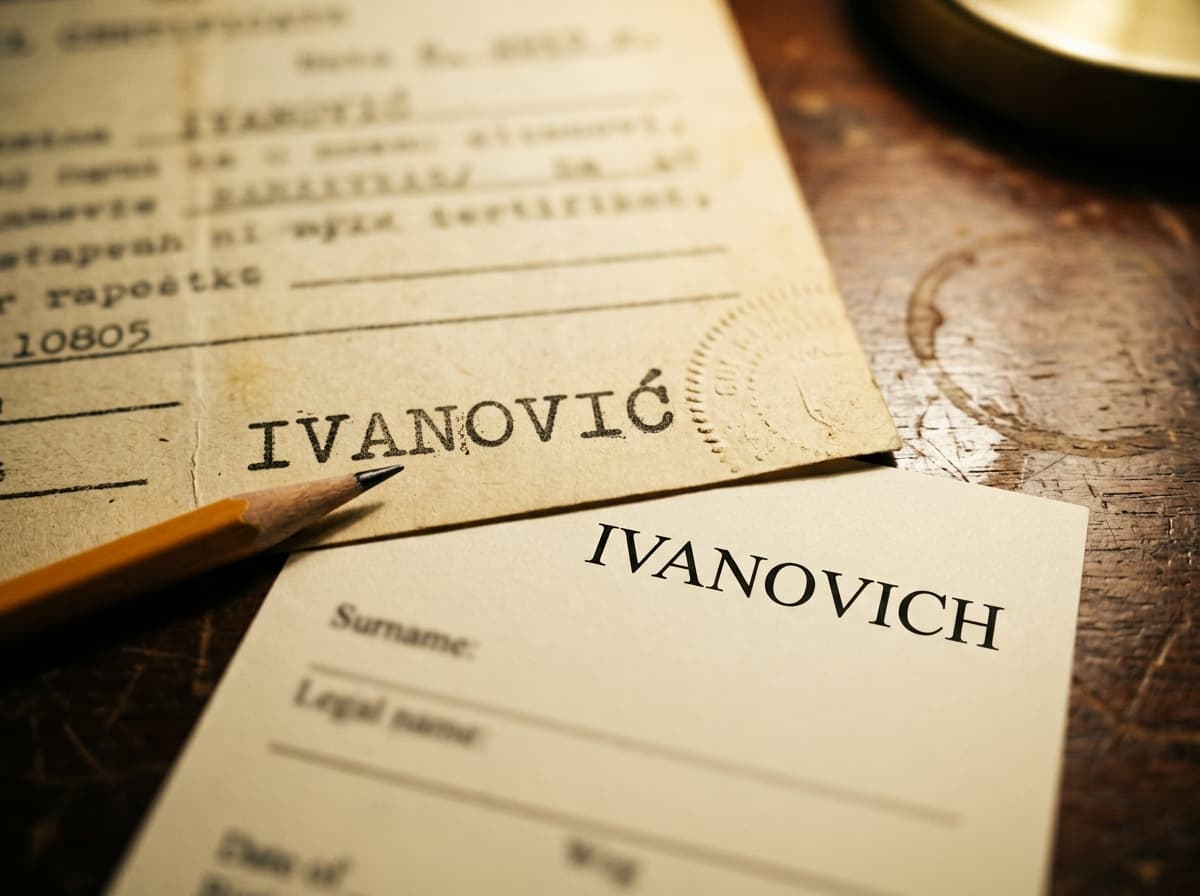
Name mismatches are the most common cause of delay in Croatian citizenship applications. The requirement is that the personal data of the applicant and their ancestors either matches what appears in Croatian registries, or that a legal change of name is documented. Most mismatches, dropped diacritics, anglicised first names, a surname changed on marriage, are entirely fixable, but each has its own fix and each has to be dealt with before the appointment, not at it.
Nobody's family documents match perfectly across four generations and two languages. That is normal. What matters is whether the file explains the gaps. This article is a companion to the complete document list for Croatian citizenship by descent, which covers the whole file; this one covers the names in it.
What the rule actually says
The Ministry of Foreign and European Affairs states it this way in its January 2025 overview: a necessary prerequisite for obtaining Croatian citizenship is that the personal information, name, date and place of birth, of applicants or their parents and ancestors either matches the personal information reflected in Croatian registries, or that proof of legal change of name is submitted.
The Consulate General in Los Angeles applies it at the document level, and its wording is worth quoting because it sets the standard:
- The passport must carry your name letter for letter matching your birth certificate or marriage certificate.
- The FBI background check must match the name on your birth certificate or marriage certificate and your US passport. The June 2025 revision widened this from "birth certificate" to "birth certificate or marriage certificate", and hardened "should match" to "must match".
- Exceptions apply where the name was changed legally by court decree or by marriage.
So there are two acceptable states: the names match, or the change is documented. Anything else is a question the Ministry will ask, and questions cost months.
The five kinds of mismatch, and how each is fixed
Five patterns cover almost every file. Each has a different fix, and the table gives them in one view before the detail.
Table: the five kinds of name mismatch in a Croatian citizenship file and the fix for each.
| Mismatch | Example | Fix |
|---|---|---|
| Diacritics dropped or transliterated | Ivanović → Ivanovic, Ivanovich, Ivanovitch | Every document showing each form, explained in the motivational letter |
| First name anglicised on arrival | Ivan → John, Josip → Joseph, Mate → Matthew | Same; the ship manifest usually shows the Croatian form |
| Woman's surname changed on marriage | Marija Kovačević appears as Mary Novak | Marriage certificate for that generation, mandatory |
| Legal name change | Court decree or deed poll | The decree, apostilled and translated |
| Middle name present on one document, absent on another | John Peter Novak vs John Novak | Usually tolerated; flag it to the post |
Croatian diacritics dropped or transliterated
Krešimir becomes Kresimir. Šimić becomes Simic, or Simich. Ivanović becomes Ivanovic, Ivanovich, or Ivanovitch. Đurđević becomes almost anything.
American, Canadian and Australian record systems historically could not handle č, ć, š, ž and đ, so they dropped them or spelled them phonetically, and often inconsistently, so the same person appears three ways across three documents.
The fix: supply every document showing each form, and explain the variation in the motivational letter. The chain of documents is what establishes that Ivanovic and Ivanović are one person. This is not a legal name change and there is no decree to produce; it is an evidential explanation.
First name anglicised on arrival
Ivan becomes John. Josip becomes Joseph. Mate becomes Matthew. Ivka becomes Eva. This happened constantly at arrival and in the decades afterwards, often without any legal act at all.
The fix: the same approach, document both forms and explain. The ship manifest is unusually valuable here, because it typically records the Croatian form of the name as written at departure, and the subsequent American or Canadian documents record the anglicised form. The manifest is the bridge. This is one of the reasons Croatian posts want the arrival record even beyond its function as proof of emigration.
A woman's surname changed on marriage
This is the most frequent and the most structural, because it breaks the chain rather than just confusing a document.
If your great-grandmother was born Marija Kovačević and appears on her son's birth certificate as Mary Novak, the surname trail between her birth record and her child's birth record simply does not connect on paper.
The fix is mandatory, not optional: the marriage certificate for that generation. Los Angeles requires it, and it is required wherever any woman in the chain changed her surname. Your parents' marriage certificate is required in all cases at Los Angeles, irrespective of whether a surname changed.
Order these early. They are as much a part of the chain as the birth certificates, and forgetting one is a very common reason a file stalls.
Descent through a woman is fully permitted, incidentally. The issue is purely evidential. One caveat: historical Yugoslav and pre-1991 citizenship rules were not always gender-neutral, and a claim that turns on a female ancestor's status before 1991, rather than just her surname, is worth having looked at properly.
A legal name change
A change by court decree or deed poll is the easiest category, because there is a document.
The fix: the court decree, apostilled and translated into Croatian, like any other foreign public document. Name change decrees are on the list of documents that require an apostille. The apostille and translation guide covers who issues it in your country.
A middle name present on one document and absent on another
Usually tolerated, but it is worth flagging to your post rather than hoping. A file where the applicant is "John Peter Novak" on the passport and "John Novak" on the FBI check is the kind of thing that generates a query.
The birthplace problem
The Ministry of Foreign and European Affairs requires a specific city of birth, and some American states issue birth certificates showing only the county or the state, not the municipality. Less well known than the name rules, and it catches people late.
The fix: order a corrected or long-form certificate that names the city. This is another reason the long form matters: the short form frequently omits exactly the fields Croatia needs, including the parents' names.
The same logic applies across the file. The long form is called different things in different countries: a Certified Copy of the Birth Registration or Statement of Live Birth in Canada, a full certificate from the GRO in the United Kingdom, an unabridged certificate in South Africa, a certidão de inteiro teor in Brazil.
What "in Croatian registries" means for the ancestor
The matching requirement runs in both directions. Your documents have to be internally consistent, and the ancestor's details have to match what the Croatian registry holds.
This is where a village name and a date of birth matter more than a surname. Croatian registry offices search on the record, not on the modern spelling of a name, and the ancestor's birth record in the matica rođenih will carry the original Croatian orthography.
If you are struggling to locate a Croatian record, the Los Angeles consulate invites you to email with the name, place of birth and date of birth of the person, and to say whether you hold a photocopy. A photocopy is enough to find the record even though it is not enough to submit. Once located, order the certified copy from the matični ured. The research guide covers how to get to the village in the first place.
Where to put the explanation
The motivational letter is the right place, and Los Angeles expressly lists "any explanations as to name changes or adoptions" as required content of it.
Keep it factual and specific. A useful paragraph names each variation, identifies which document shows which form, and states plainly that they refer to one person. Something like: "My great-grandfather appears as Ivan Ivanović on his 1889 birth record from Vrgorac, as Ivan Ivanovich on the 1911 passenger manifest, and as John Ivanovich on his 1915 marriage certificate and his death certificate. All three refer to the same person."
That is the paragraph that saves a query. Vagueness is what generates one.
The letter must be in Croatian. Where you do not read, speak and write Croatian, Los Angeles requires the English version alongside, Croatian on top, with photocopies of both.
Adoption and unclear paternity
Adoption is not the same problem as a name mismatch, and it is worth separating out.
An adopted person claiming through biological Croatian ancestry has a genuinely difficult file, because the paper chain and the blood chain diverge. Los Angeles asks for adoptions to be explained in the motivational letter, but the underlying question of which chain the Ministry will accept is a legal one, not a documentation one.
Similarly, where a child was born out of wedlock or paternity is unclear, the chain depends on legally established parentage, not biology. If the father is not on the birth certificate, that link does not exist on paper. The options are acknowledgement of paternity, a court judgment, or routing the claim through the mother's line instead.
Both of these are cases to take advice on before ordering documents, because the wrong chain is an expensive thing to assemble. Croatian Roots puts them in front of the Croatian lawyers it works with rather than answering them with a document list.
Next step
Name problems are cheap to solve early and expensive to solve at the consulate. If your chain has a surname that changed, an ancestor who appears under several spellings, an adoption, or unclear paternity, it is worth mapping the documents before you order any of them. The free eligibility check takes about a minute; a consultation ends with a document checklist written for your line.
Read next: the complete document list · apostille and certified translation, country by country · proving your ancestor emigrated
Common questions
Q1My surname lost its diacritics three generations ago. Is that a problem for Croatian citizenship?
Not usually. Šimić becoming Simic or Simich is an evidential explanation, not a legal defect. Supply every document showing each form of the name and explain the variation in the motivational letter, naming which document shows which spelling. The chain of documents is what establishes that the spellings refer to one person.
Q2Do I need to legally change my name back to the Croatian spelling?
No. Nobody expects you to. The requirement is that the personal data in your file either matches what appears in Croatian registries or that a legal change of name is documented. Different spellings across generations are documented by producing the certificates that show each form, not by changing your name today.
Q3My grandmother's maiden name is on her birth certificate and her married name is on my father's birth certificate. What do I do?
Order her marriage certificate. It is mandatory for that generation because it is the document that connects the two surnames, and without it the chain cannot be read on paper. The Consulate General in Los Angeles requires it wherever a woman in the chain changed her surname, and your parents' marriage certificate in all cases.
Q4My name changed when I married. Which name should my documents be in?
Your documents need to be internally consistent, and the marriage certificate documents the change. Los Angeles accepts the FBI check matching either the birth certificate or the marriage certificate, provided the change is documented, and its June 2025 list requires the passport to match one of them letter for letter.
Q5My birth certificate only shows the county, not the city. Does that matter?
Yes. The Ministry of Foreign and European Affairs requires a specific city of birth, and some American states issue certificates showing only the county or the state. Order a corrected or long-form certificate that names the city. The long form is also the version that shows the parents' names, which the chain needs.
Q6My ancestor's name is spelled three different ways across three documents. Is the claim dead?
No. That is typical of the period and not an obstacle in itself. Produce all three documents, explain the sequence in the motivational letter, and let the ship manifest do the bridging work where it shows the original Croatian form of the name before it was anglicised on arrival.
Croatian Roots
Citizenship-by-descent casework, Zagreb
Reviewed by Luka Miletić, Founder, Croatian Roots. Last reviewed 20.09.2026.
SOURCES
General information about Croatian law, not legal advice, and not a prediction of any outcome. Requirements vary by consular post and change without notice. Every application is decided by the Ministry of Internal Affairs of the Republic of Croatia.
Last reviewed 20 SEPT 2026
- name mismatch
- diacritics
- anglicised surname
- marriage certificate
- motivational letter
- documents